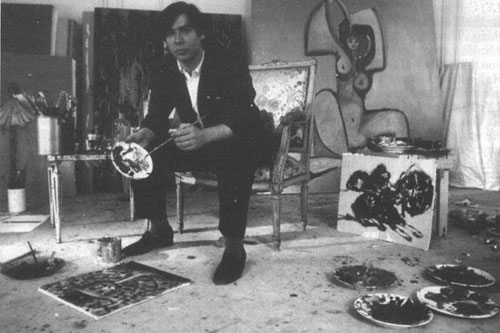
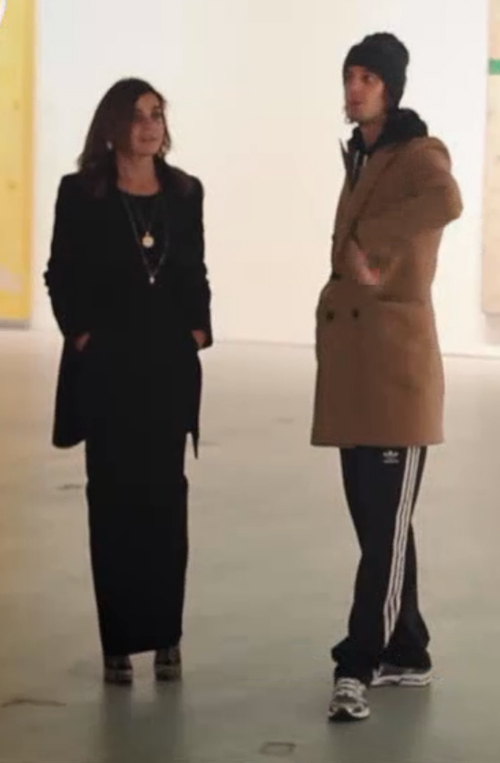
When faced with the question, "Who's your favorite living artist?" Vladimir Restoin-Roitfeld responded, "So MANY — Tom Sachs and George Condo are a few of my favorites." According to The New York Times, Vladimir even took time out from installing an exhibit by RETNA to accompany the artist to see "George Condo: Mental States" at the New Museum in February 2011. Born in rural New England in 1957, George Condo was drawn to 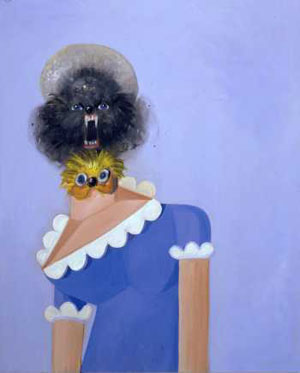 New York City at a young age, gravitating naturally to the East Village circle of artists that included William Burroughs, Keith Haring, Julian Schnabel, and Jean-Michel Basquiat, and spending time as a printer in Andy Warhol's Factory. Today Condo is renowned for his fine skill in handling paint like an Old Master with a focus on fantastical portraiture; he is also an accomplished sculptor.
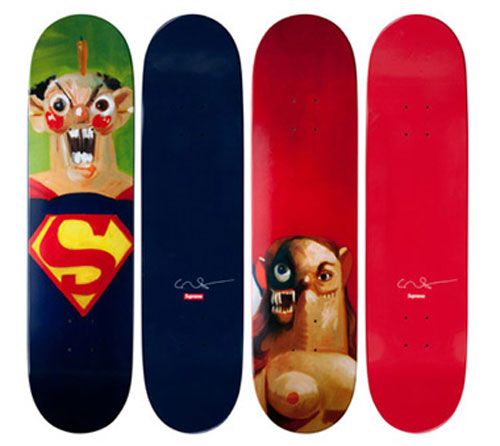
George Condo talks about his vision: "There was a time when I realized that the central focal point of portraiture did not have to be representational in any way. You don't need to paint the body to show the truth about a character. All you need is the head and the hands." The artist lives in an Upper East Side townhouse with wife, Anna, and daughters, Eleonore and Raphaelle, and travels seven blocks to paint in another UES townhouse which serves as his studio. I love the ways in which Condo's work touches popular culture: his paintings which serve as cover art for Kanye West’s album, My Beautiful Dark Twisted Fantasy, and his partnership with Supreme to create a line of skateboard decks, to name just two examples.

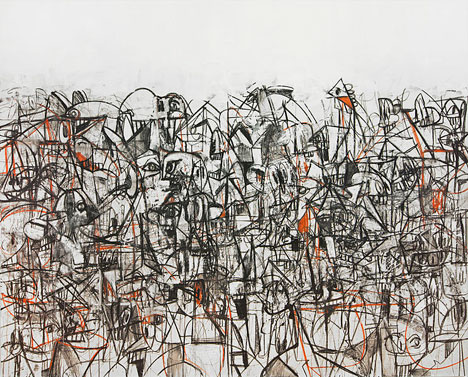
"Abstract Conversations," George Condo (2012)
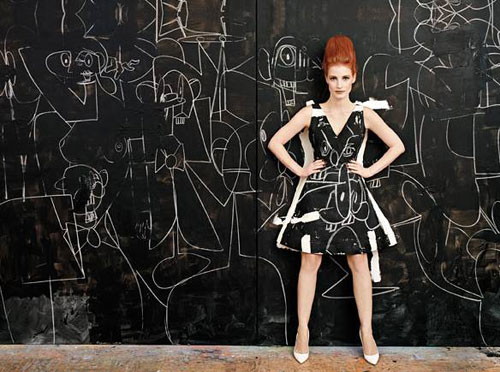
W, January 2013, "Art Meets Fashion" issue
Stylist: Felicia Garcia-Rivera; Model: Jessica Chastain; Photographer: Max Vadukul
George Condo was one of the four artists chosen by W Magazine to render Jessica Chastain for the covers of their "Art Meets Fashion" issue in January 2013. I love Condo's vision for the work so much that I have copied it here in its entirety: "'I love the idea of two incompatible worlds brought together — opposing forces harmonically melded.' When he met Chastain, his plan was to create two artworks — and cast her not as their subject but as a character in them. 'I wanted Jessica to become part of the painting and then appear to come off it, as if she were breaking free and leaving behind an empty space… I liked that the paintings were 3-D.' To achieve that effect, Condo designed two simple canvas dresses for Chastain, taping them to the canvas and painting over them so that when they were removed, they would leave a blank space but appear to be a fragment of the piece. 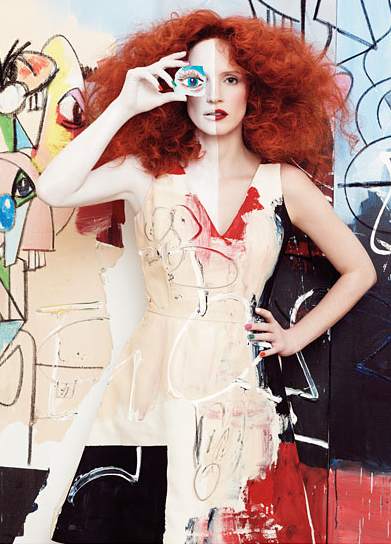 Standing in front of Condo's Abstract Conversations, 2012, with her red hair teased to eternity, Chastain blended into the cacophony of line and color, a member of the loopy crew. As Condo studied Chastain posing next to the other figures in the work, he began drawing a cluster of noisy characters close to her head to give the impression 'that they were yelling into her ear.' While Chastain was having white makeup applied to half her face, Condo grabbed a scrap of paper and created an eye for her to use as a prop. 'I thought if she just held it in front of her, it would give a real sort of Stanley Kubrick feel to the experience.' The result, of course, is suitably schizoid, just as Condo envisioned. 'With that popped-out eye, there are two different sides to her face: one hysterical and the other soulful… Multiple emotions at the same time.'”
View the creation of the cover by George Condo and Jessica Chastain for W
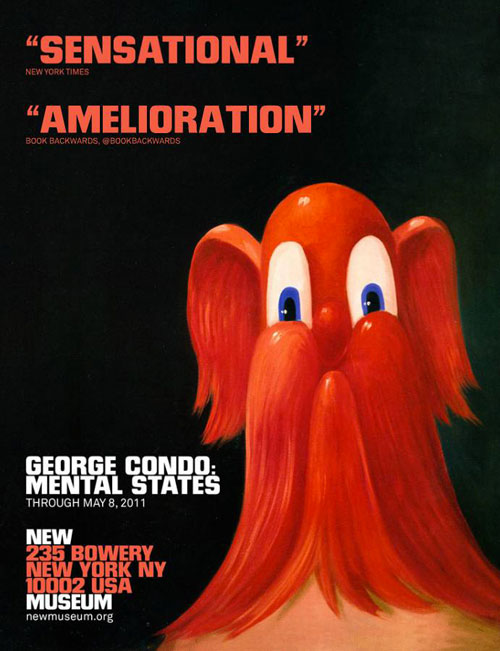
The exhibit that attracted the attention of Vladimir Restoin-Roitfeld, RETNA, and many other discerning art lovers was George Condo: Mental States , a survey of the work of the artist from 1982 to 2011. With 125 color photographs of Condo's work plus 16 additional plates exclusive to the exhibit, the catalog makes a fine consolation for anyone that missed the show.
View the exhibit "George Condo: Mental States" at the New Museum
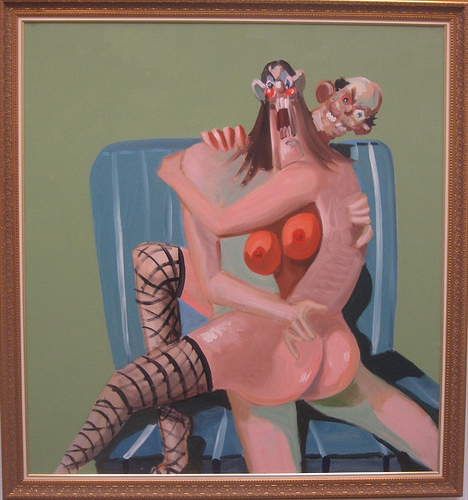
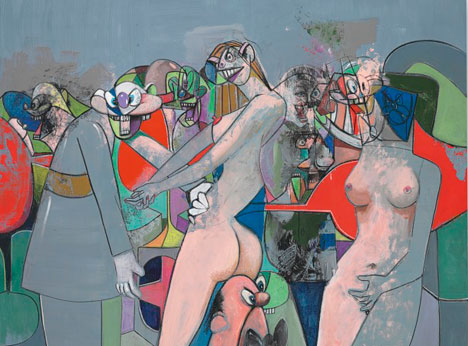 George Condo, "The Manhattan Strip Club" (2010) recently sold at Christie's for $1.3 million.
George Condo photograph © 1989 Marianne Haas."George Condo: Mental States" poster courtesy of newmuseum.org. W cover image by George Condo © 2013 Condé Nast. George Condo work © George Condo and courtesy of Christie's.



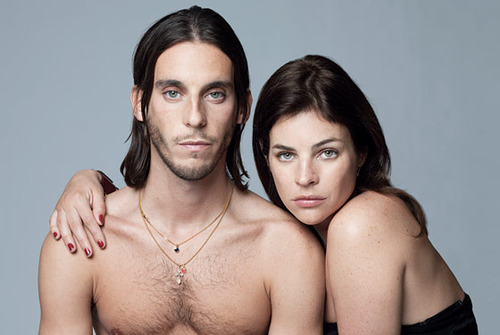

 Vladimir Restoin-Roitfeld in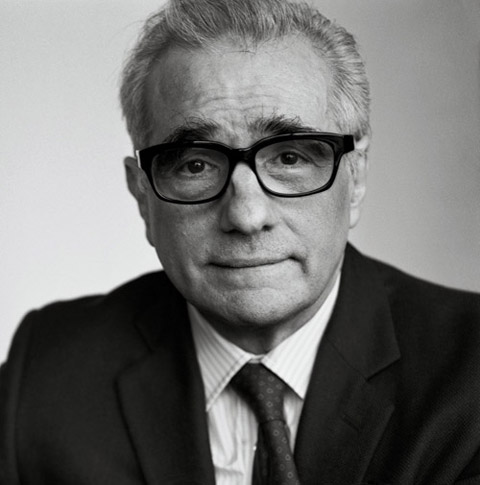
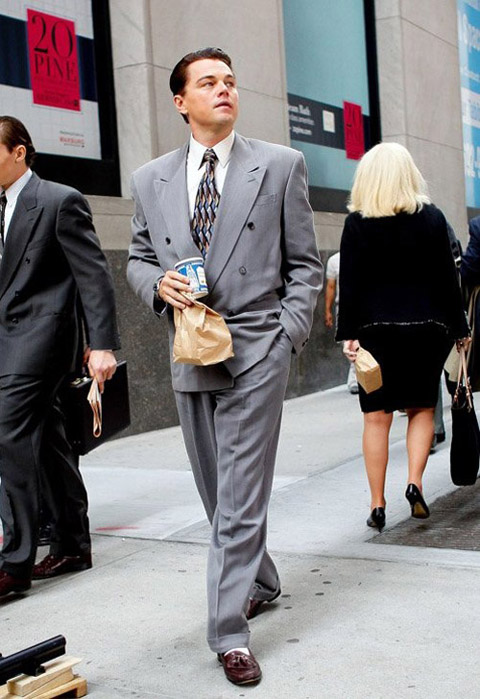
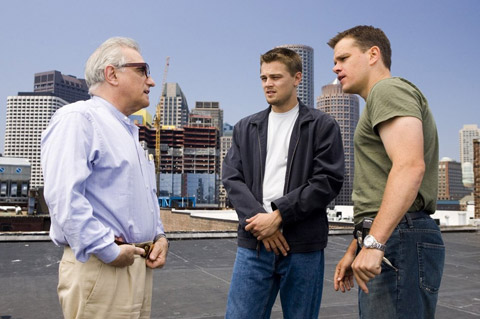
 — surprisingly the only movie for which he has won the Academy Award for Best Director was filmed in my backyard,
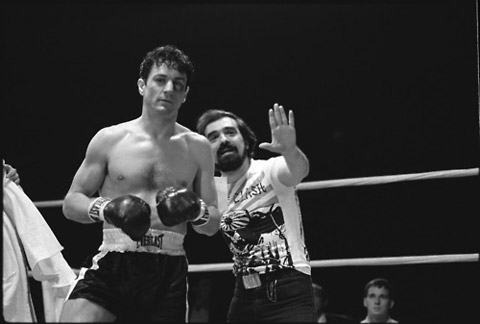
  . On a side note, one can’t but wonder if the director Fabien Constant utilized any of Scorsese’s techniques when filming his Carine Roitfeld documentary, Mademoiselle C.; Scorsese did direct the famous
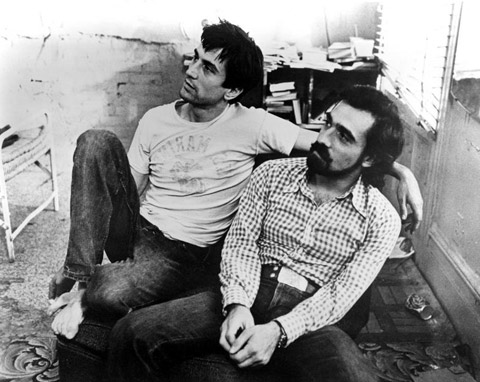
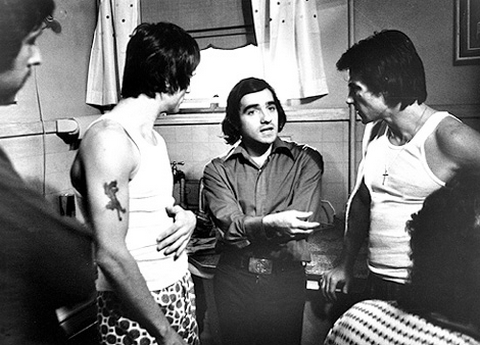
  and films in a documentary style. There is no question, Marty assuredly knows what’s in the frame and what’s out...